Decoration
A field guide to brogues
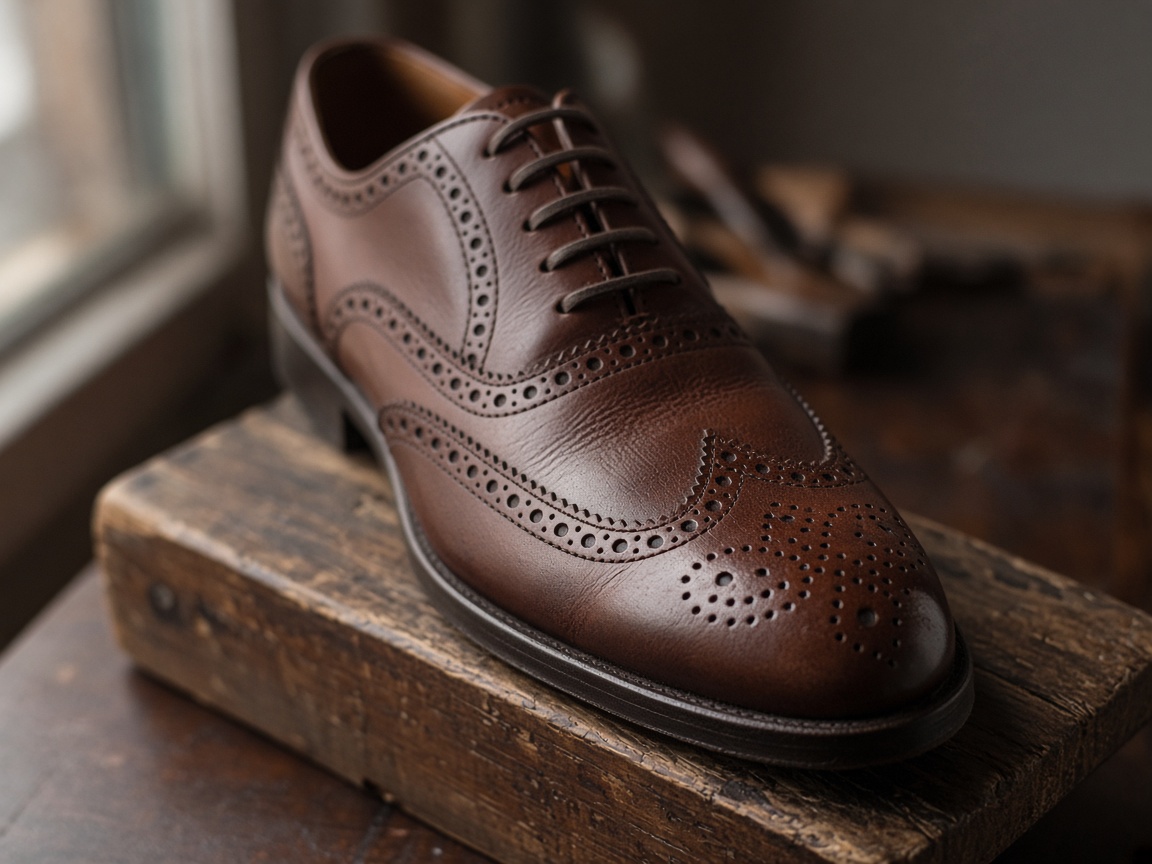
Full brogue, semi-brogue, quarter brogue, and the longwing. Punching is decoration, and it changes how formal a shoe is.
What the holes are doing
Brogues are punched. A line of holes follows a seam, a wing, or a cap toe. The old country shoe, Scottish and Irish, is often said to have been punched so water could leave the seams. A modern calf brogue does not drain, and it is not a rain shoe. The punching is decoration.
Decoration changes the manner of the shoe. A plain oxford is a closed surface. A brogue breaks that surface. The more leather you punch, the less severe the shoe becomes.
Pinking, the saw-tooth edge along a wing or a cap, travels with the punching. Together they mark the shoe as a brogue even before you count the holes. Smooth edges with a few holes along a seam are the quieter end of the same family.
Do not confuse punching with construction. A full brogue can be Goodyear-welted or Blake-stitched. The holes do not make the shoe stronger or weaker; they only change how formal it looks next to a suit or a jacket.
Wing, cap, and seam
A full brogue, often called a wingtip, has a toe cap cut as a W. The wing runs out toward the waist, and the edges are pinked and punched. In brown or walnut calf it belongs with flannel, tweed, and cavalry twill. It is a poor match for a black worsted suit.
A semi-brogue keeps a straight cap toe, adds a medallion of punching in the center, and runs a row of holes along the cap. This is the brogue that can still go with a suit, in black or dark brown. Cheaney and Loake both make that kind of office shoe.
A quarter brogue is the quiet one. The holes sit only along the seams, with no medallion. From a few feet away it reads as a plain shoe.
Walk the three styles past the same jacket. The full wing asks for texture in the cloth. The semi-brogue will take a navy suit if the leather is dark and the sole is modest. The quarter brogue can sit under a worsted without drawing the eye to the shoe.
Names wander in shops. “Wingtip” usually means the full brogue. “Medallion” means the punched pattern in the centre of a cap. If a listing says only “brogue,” look at the photograph: count whether the wing reaches the waist, and whether a medallion is present.

The longwing
On a longwing the wing does not stop at the waist. It runs back to the heel seam, so the punching circles the shoe. The shape is American, from the country-and-ivy wardrobe, and fewer of them come from the English, Italian, and Spanish makers in this index.
For that heavier country feeling from a listed maker, look at Tricker's. The sole is the point there, more than a wing that reaches the heel.
If you want the longwing silhouette from a Spanish factory that already speaks English brogue, Berwick is closer to that vocabulary than most Italian lasts. Still try the last; the wing is decoration, not fit.
A longwing with a thick sole and a storm welt is a weekend shoe. The same wing on a thin black calf would look odd under a city suit. Match the decoration to the sole and the cloth, not only to the name of the style.
Leather and colour
Smooth calf shows punching cleanly. Grain leather softens the pattern. Suede softens it further, and moves the shoe toward leisure even when the pattern is a quarter brogue.
Black punching stays nearer the office. Mid-brown and walnut move toward odd jackets. Cordovan and high-shine calf can take a semi-brogue into evening cloth if the pattern stays quiet. White and pale suede belong with warm weather and open shirts, not with a black suit.
Two-tone brogues—light wings on a dark body, or the reverse—are a separate manner. They read as sporting history. This index is built around single-colour classical shoes; treat two-tone as an exception you choose on purpose, not as a default office pair.
How much punching
Use the punching as a measure of severity. A black quarter-brogue oxford is almost a plain oxford. A brown full brogue is a sport-coat shoe. A suede brogue is more casual still.
Gaziano & Girling punches on a contemporary English last, with a high polish. Berwick borrows the English brogue vocabulary and makes it in Spain. Start with one semi-brogue in dark calf before you add a full wing.
If your wardrobe is mostly suits, own the quiet brogue first. If your wardrobe is mostly odd jackets, the full wing will earn more days. The punching should follow the cloth you already wear, not a photograph of a shoe you admire in isolation.